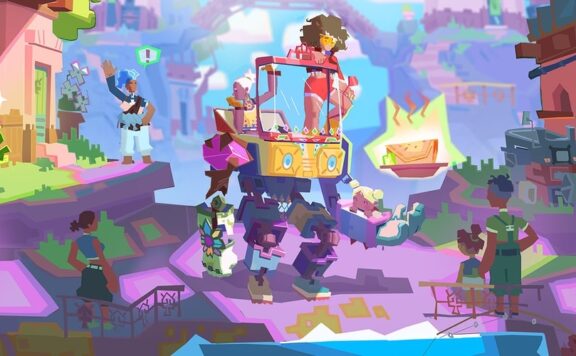


There is nothing quite like having a good meal right when you need it. It could be a simple dish that is a comforting favourite after a long day, or a complex dish that takes effort which gives you a sense of accomplishment when you eat it. Food can be enjoyed alone and can be a uniter, a shared experience with family, friends, and even strangers. Dosa Divas is about our relationship with food and how it also impacts our bonds with others, but in this case, it can be a source of familial trauma.
Dosa Divas follows sisters Amani and Samara, along with their mech Goddess, as they travel the land on a mission to go to see their parents. It is a trip that has been a long time coming, with Amani having been away for a decade, ever since an accident at the old family restaurant broke the family and their friends apart to go their separate ways.
The land Amani comes back to is very different from the one she left behind, with cooking essentially outlawed and everyone surviving on tube meals developed by the corporation LinaMeals. LinaMeals has taken over villages, forcing the residents to work for them, to give up cooking and survive on the tubes of paste they produce. Seeing this Amani, Samara, and Goddess embark on a mission to bring back cooking and loosen LinaMeals’ grip on the people, while also trying to repair their relationship with each other and their loved ones.
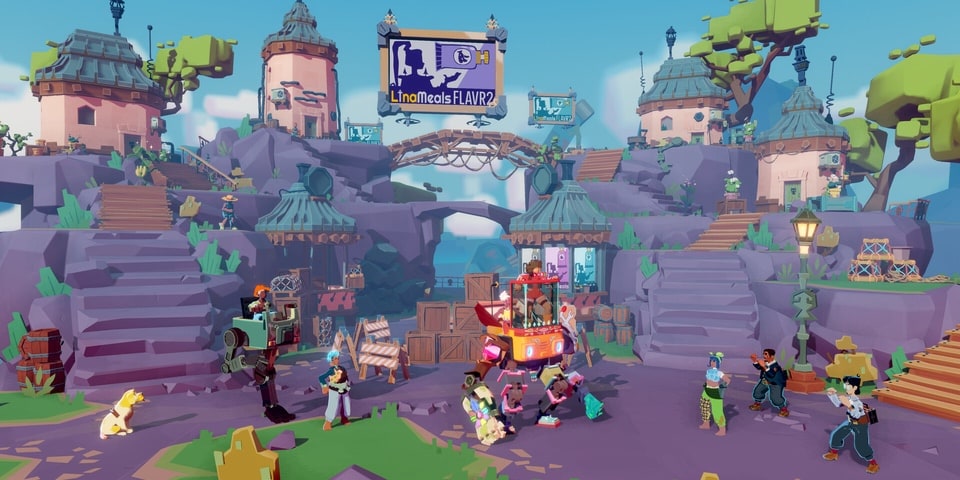
The world of Dosa Divas consists of three different villages to save. You have the fishing village of Buroth which is staging its own fight against LinaMeals, the underground village of Canopea that was forced their by LinaMeals to gather resources, and the resort village of Port Zest. Each of these places is filled with people that need real food, which is still growing but off limits, and something to fight against LinaMeal’s army of lawyers, enforcers, and venture capitalists.
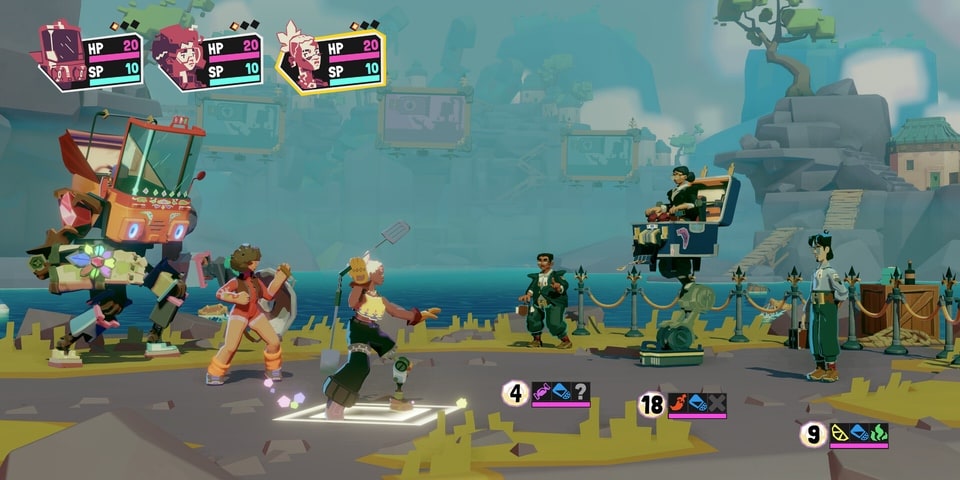
Fights against these enemies consist of turn based battles. Goddess, Amani, and Samara have basic attack and special attacks, both of which have types including sweet, spicy, and sour. This is important as enemies are weak to different types of attacks, and connecting with the right one can break through defences to make enemies enter a stuffed state. In this state, enemies take a lot more damage. Alongside the basic and special attacks, there are also ultimates to unlock which the whole party use as one. Ultimates can be straightforward attacks or abilities that boost attack and defence.
I was hoping for a bit more variety in attacks between characters, as each one unlocks variants of the same attack. Blocking is an important part of battles too. If you time your input precisely, you can negate any damage coming in. Even if you don’t time blocks perfectly, you can still offset some incoming damage. Items also play an important part in keeping the team going, and most items are the meals that you make, a key component of Dosa Divas.
Each area of Dosa Divas’ world has specific ingredients that you can gather. For example, you can only get mangos in Buroth, fire salt in Canopea, and cherry chillies in Port Zest. When you gather ingredients you can enter the prep realm to make different dishes. There are set dishes that people crave and you can make, but Dosa Divas also lets you experiment with ingredients to see what kind of dishes you can discover yourself.
Cooking in Dosa Divas consists of a minigame that requires different things to do depending on the dish. You may have to spread batter in the pan, and this means rotating the analogue stick on your controller to find a good speed, though I found this the most cumbersome of the minigames and not a totally smooth experience. Other parts of the minigame include pouring and making sure the pour stops at the right level, chopping which requires you to press a button at the right time, keeping a dot within the centre of a circle, rapidly pressing a button to add seasoning but stopping at the right times, and another minigame that requires pressing a button at the correct time. To be honest, the cooking minigame is pretty simple, short, and straightforward. I enjoyed seeing what dishes would come up (as well as taking notes to look up recipes for some dishes), but preferred the exploration side of Dosa Divas.

Dosa Divas’ story is pretty hard hitting and tackles some big themes. You have family trauma to deal with as the sisters navigate their complicated relationships with each other, former friends, and their parents. There are struggles with perfectionism, people pleasing, abandonment, and resentment. It does not shy away from how complex relationships can be and how individual actions can impact others in a negative way, sometimes without us realising. Dosa Divas also shows how the journey to reconciliation and forgiveness is hard, and not everything can be solved in an instant. Throughout the roughly 10 hours it took to see the credits roll, Dosa Divas managed to provide some delightful moments but also many moments of hardship that may make you reflect too. The last message that pops up at the end made me reflect on my own relationships and how food has played a part in them.
I did like Dosa Diva’s visual style, full of vibrant colours and laid out so it was easy to navigate. The music is well composed too with the different battle music sounding good, but my favourite track is the one that plays as you wander the overworld. It is a simple, more traditional South Asian rhythm and it felt so familiar having grown up with that kind of music in my life.